

Sales training is no longer a discretionary expense but a critical operational lever for growth. According to recent industry data, organizations that invest in structured sales development see an average return on investment of 6X compared to those that do not. However, the path to achieving that ROI depends heavily on the delivery model chosen. Companies must decide between bespoke in-house programmes and open enrollment courses. This decision impacts not only immediate budget but also long-term cultural alignment and skill retention. (Contact Us Get in)
Understanding the Core Models
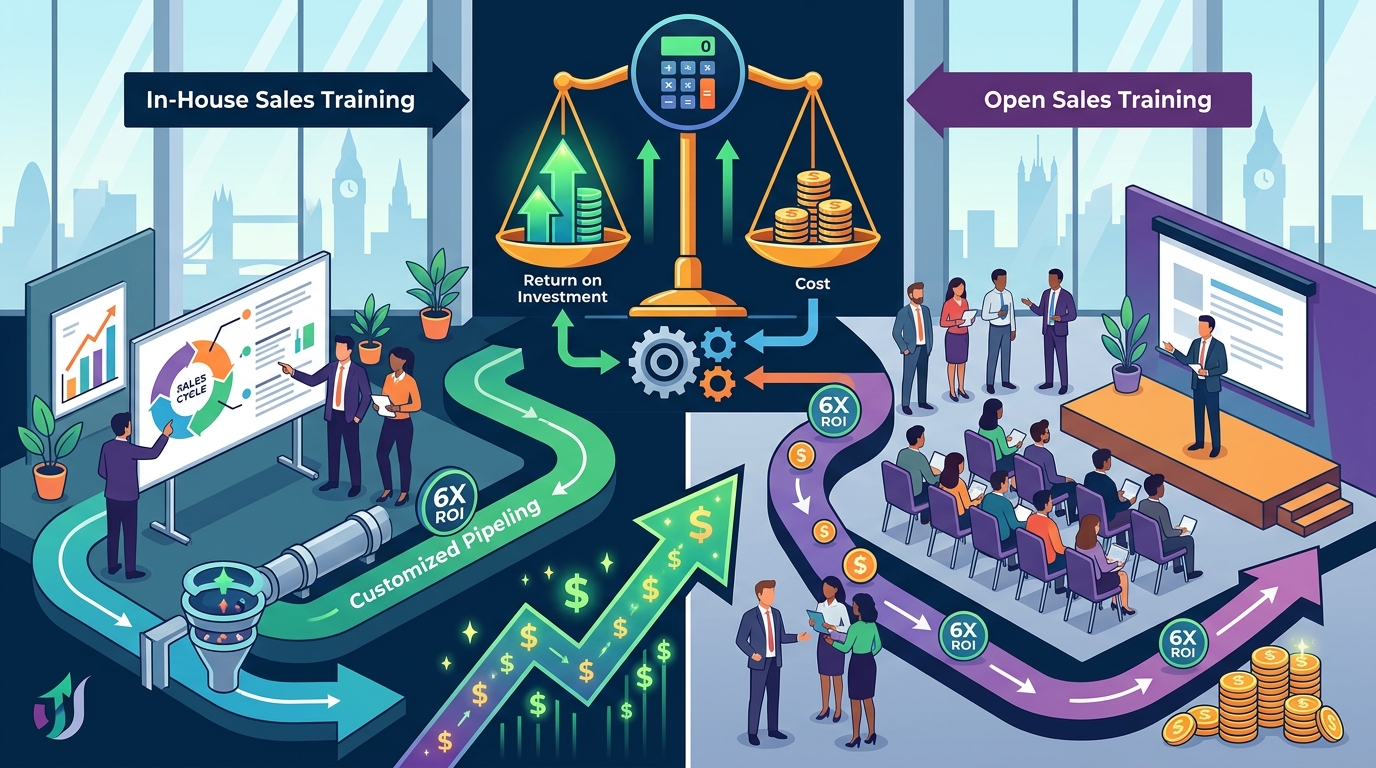
Before diving into the financials, it is essential to define the operational scope of each training type. In-house sales training is a fully customized programme designed specifically for one organization. It addresses unique market challenges, internal processes, and specific team dynamics. Open sales training is a pre-designed course where participants from various companies attend together. It focuses on universal sales principles and best practices applicable across industries.
The choice between these two models often hinges on the maturity of the sales team and the specificity of their challenges. For teams struggling with complex, high-value deals, bespoke training offers immediate relevance. For individuals seeking to sharpen foundational skills, open courses provide a cost-effective networking opportunity.
Cost-Benefit Analysis: In-House Training
In-house training represents a higher initial investment but often yields a steeper ROI curve for established teams. The primary benefit is contextual relevance. When training is tailored to your specific CRM, your ideal customer profile, and your current sales methodology, the learning curve is significantly reduced. Employees can apply new techniques from day one because the scenarios mirror their daily reality.
From a financial perspective, the cost structure is fixed. You pay for the entire programme regardless of how many seats are filled. This makes it ideal for large teams where the per-head cost drops substantially. For example, a bespoke sales programme might cost a flat fee for a three-day workshop. If twenty salespeople attend, the cost per person is manageable. If only five attend, the cost per person is high.
However, the benefits extend beyond direct revenue. In-house training fosters team cohesion. It allows managers and reps to align on a shared language and process. This alignment is critical for scaling operations. According to McKinsey research, organizations with aligned sales processes see faster revenue growth than those with fragmented approaches. In-house training ensures that alignment happens internally.
The downside is the lack of external perspective. Your team may become too insular, reinforcing existing bad habits if the facilitator is not rigorous. Additionally, scheduling can be difficult. Coordinating the availability of an entire sales team for multiple days requires significant logistical effort.
Cost-Benefit Analysis: Open Training
Open training programmes offer a low-barrier entry point for skill development. The primary benefit is cost efficiency for individuals or small teams. You pay only for the seats you need. This model is particularly effective for onboarding new hires or upskilling specific individuals who need exposure to diverse sales environments.
Another significant advantage is the networking opportunity. Participants learn alongside peers from other industries. This cross-pollination of ideas can spark innovation. A salesperson might learn a technique from a competitor in another sector that solves a problem in their own market. This external perspective is something in-house training rarely provides.
Financially, open courses are priced per participant. This scales linearly. If you have five people to train, you pay for five seats. If you have fifty, you pay for fifty. This predictability helps with budgeting. However, the lack of customization means the content may not address your specific pain points. You must adapt the universal principles to your context, which requires additional internal coaching.
Open training is also less disruptive to daily operations. Sessions are often shorter or scheduled at regular intervals, allowing teams to continue working without the extended absence required for in-house workshops. This makes it easier to justify for time-poor sales teams.
Comparative Overview
The following table summarizes the key differences between in-house and open sales training programmes. This comparison highlights the trade-offs between customization, cost, and strategic impact.
| Factor | In-House Training | Open Training |
|---|---|---|
| Customization | High. Tailored to specific processes and challenges. | Low. Focuses on universal sales principles. |
| Cost Structure | Fixed fee. Lower per-head cost for large teams. | Variable. Paid per seat. Scales linearly. |
| Team Alignment | High. Builds shared language and culture. | Low. No internal cohesion benefit. |
| External Perspective | Limited. Focuses on internal dynamics. | High. Exposure to diverse industries and peers. |
| Implementation Speed | Immediate. Applies directly to daily work. | Delayed. Requires internal adaptation. |
| Best For | Large teams, complex sales, strategic alignment. | Individuals, small teams, foundational skills. |
Key Takeaways
- ROI Potential: In-house training often delivers a higher ROI for mature teams due to immediate applicability and team alignment.
- Cost Efficiency: Open training is more cost-effective for small teams or individual skill development.
- Strategic Alignment: In-house programmes are superior for standardizing sales methodology across an organization.
- Networking Value: Open courses provide unique opportunities to learn from peers in different industries.
- Scalability: In-house training scales better for large organizations, while open training scales easily for individual needs.
- Implementation: In-house training reduces the time between learning and application.
- Flexibility: Open training offers more scheduling flexibility and lower logistical barriers.
Frequently Asked Questions
Which is more cost-effective for a team of five?
Open training is typically more cost-effective for small teams. The per-seat cost is usually lower than the fixed fee of a bespoke in-house programme, which is designed to amortize costs over larger groups.
Can open training replace in-house training?
Open training can complement in-house training but rarely replaces it entirely. Open courses provide foundational skills and external perspectives, while in-house training addresses specific internal challenges and ensures team alignment.
How long does it take to see results from in-house training?
Results from in-house training can be seen immediately because the content is tailored to your current processes. Participants can apply new techniques to their daily work from the first day back in the office.
Is open training suitable for senior sales leaders?
Open training can be suitable for senior leaders seeking broad industry insights and networking. However, for leaders needing to implement specific strategic changes, bespoke leadership training may be more effective.
What is the average ROI of sales training?
According to industry benchmarks, organizations that invest in structured sales development see an average return on investment of 6X. This figure varies based on the quality of the training and the implementation of new skills.
How do I choose between virtual and in-person training?
The choice depends on your team's preferences and the complexity of the content. In-person training often fosters better engagement and networking, while virtual training offers convenience and flexibility. Impel Dynamic offers both virtual and in-person options to suit your needs.
Does Impel Dynamic offer both types of training?
Yes, Impel Dynamic specializes in both bespoke in-house programmes and open enrollment courses. Our approach ensures that you receive training tailored to your specific environment, whether through a customized sales training programme or an open course.
Next Steps
Choosing between in-house and open sales training is not a binary decision. Many successful organizations use a hybrid approach. They invest in open training for individual skill development and in-house training for strategic alignment. The key is to align your training strategy with your business goals.
If you are ready to accelerate your sales growth, we invite you to book a call with Impel Dynamic. Our experts will help you design a scalable sales process that drives long-term conversion rates. Whether you need a bespoke programme or guidance on open courses, we are here to help you win more business.