

Choosing between in-house and open sales training depends on your team size, budget, and specific skill gaps. Open courses offer peer learning and lower upfront costs, while in-house programmes provide deep customisation and immediate application. This guide explains how to select the right format for your organisation.
How to Choose the Right Format
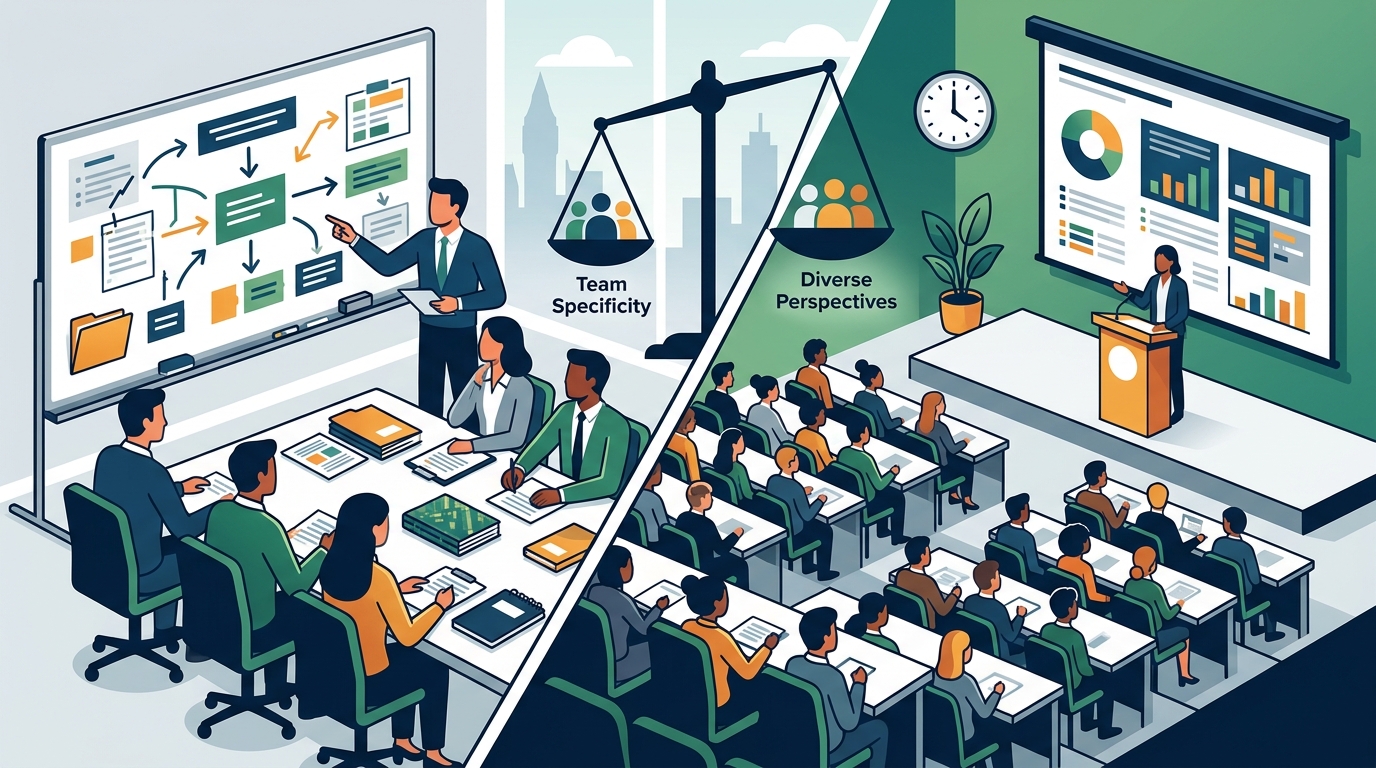
Selecting the correct training delivery method is the first critical step in sales development. In-house sales training is a customised programme delivered exclusively to your organisation, tailored to your specific products, culture, and challenges. Open sales training is a pre-scheduled course where participants from different companies learn together in a shared environment. The choice hinges on three factors: team size, the need for customisation, and budget constraints.
If you have a large sales force, in-house training is often more cost-effective per head. It allows trainers to use your actual case studies and data. If you have a small team or individual professionals, open courses provide immediate access to expert-led content without the overhead of hiring a full-time trainer. Impel Dynamic offers both formats, allowing you to select the approach that best fits your current growth stage.
Team Size and Cohesion
Customisation Depth
In-house programmes allow for deep customisation. Trainers can interview your team, analyse your pipeline data, and design exercises around your specific objections. Open courses follow a standard curriculum. While the core skills are universal, the examples are generic. If your sales process is highly complex or niche, in-house training is usually the superior choice.
Questions to Ask Before Committing
Before booking any training, you must ask specific questions to ensure the provider can deliver results. Do not settle for vague promises. Ask the provider to explain their methodology in detail. How do they measure success? What does the pre-work look like? What is the follow-up process after the training day ends?
Ask about the trainer's background. Are they active sales professionals? Do they have experience in your specific industry? Impel Dynamic's consultants hold extensive experience in high-level sales and management roles. They remain involved in day-to-day business development activities to ensure their training approaches are current and relevant. This practical experience is a key differentiator from academic-only trainers.
Methodology and Framework
Ask for a clear description of the sales framework being taught. Is it a proprietary model or a generic one? A strong provider will be transparent about their approach. Impel Dynamic uses a proven methodology that focuses on initiating change through methodical, well-structured steps. Understanding the framework helps you assess if it aligns with your company's culture.
Post-Training Support
Training is an event, but behaviour change is a process. Ask what support is available after the course. Do they offer coaching sessions? Are there follow-up workshops? Impel Dynamic's approach includes a "Prepare, Deliver, Follow-Up" methodology. This ensures that the skills learned are reinforced and embedded into daily practice, rather than forgotten a week later.
Verifying Credentials and Claims
The sales training market is crowded with providers making bold claims. You must verify these claims before investing. Check the trainer's LinkedIn profile to see their actual work history. Have they held senior sales roles? Have they managed teams? A trainer who has only taught sales but never sold is less credible than one who has closed complex deals.
Ask for case studies. Can the provider share examples of how their training improved specific metrics for similar companies? Look for quantifiable results, such as increased win rates or higher average deal values. Impel Dynamic's clients have closed significant new deals since training with them. While specific numbers vary by client, the provider's track record of helping organisations secure new business and retain high-value clients is a strong indicator of effectiveness.
Checking References
Request references from past clients. Speak to them directly. Ask what changed in their team's behaviour after the training. Did the skills stick? Were there any issues with the delivery? First-hand accounts are the best way to verify a provider's quality. If a provider is reluctant to provide references, that is a red flag.
Assessing Cultural Fit
Training is not just about content; it is about delivery style. Watch a sample session or speak to the trainer. Do they communicate in a way that resonates with your team? Impel Dynamic's team is hand-picked for their ability to engage and motivate. A good fit between the trainer's style and your team's culture is essential for maximum impact.
The Training Process and Timeline
Understanding the timeline helps you plan the investment. Open courses are typically one or two days long. They are scheduled in advance, and you book a seat. In-house programmes are more flexible. They can be one day, two days, or a multi-week series. The timeline depends on the depth of customisation required.
The process usually begins with a discovery phase. The trainer meets with your leadership team to understand your goals and challenges. They may interview sales reps to identify specific skill gaps. Based on this, they design the curriculum. The training day itself is interactive, involving role-plays, discussions, and practical exercises. After the training, there is a follow-up phase to reinforce learning.
Pre-Training Preparation
Effective training starts before the day begins. Participants are often asked to complete a pre-training questionnaire. This helps the trainer customise the content to the delegates' specific needs. You should also bring your action plans, targets, and objections to the training. This ensures the sessions are practical and actionable. Impel Dynamic customises course content for delegates based on these pre-work inputs.
Delivery and Follow-Up
During the training, the focus is on application. Trainers guide participants through real-world scenarios. After the training, the follow-up phase is critical. This may include coaching calls, review sessions, or additional workshops. Impel Dynamic's methodology emphasises follow-up to ensure lasting change. This ongoing support helps bridge the gap between learning and doing.
Cost Drivers and Budgeting
Cost is a major factor in the decision. Open courses are generally less expensive per person. You pay for a seat in a shared class. In-house training is more expensive upfront because you are hiring the trainer exclusively for your team. However, the cost per head can be lower for larger groups. The total cost depends on several drivers.
The primary cost drivers are the number of participants, the duration of the training, and the level of customisation. A one-day open course is the most affordable option. A multi-day in-house programme with deep customisation and follow-up coaching is the most expensive. Impel Dynamic offers a range of options, from open courses to bespoke programmes, allowing you to align the investment with your budget and goals.
Return on Investment
When budgeting, consider the return on investment. How much is one additional sale worth? If the training helps your team close even one extra deal, it may pay for itself. Calculate the potential ROI based on your average deal value and win rate. This helps justify the investment to stakeholders. Impel Dynamic focuses on maximising training ROI by providing actionable frameworks that drive immediate results.
Hidden Costs
Consider hidden costs. Travel and accommodation for open courses can add up. Downtime for your team during in-house training is another factor. Factor these into your total budget. A slightly more expensive in-house programme might be cheaper overall if it saves on travel and allows for more focused learning.
Common Mistakes to Avoid
Many organisations make mistakes when selecting sales training. The most common error is choosing a provider based solely on price. Cheap training often lacks depth and follow-up. Another mistake is not involving the right people. If the sales leaders are not engaged in the training, the team is less likely to adopt the new skills.
A third mistake is expecting immediate, dramatic results. Behaviour change takes time. Training is the catalyst, but consistent practice and reinforcement are needed for lasting change. Impel Dynamic's approach addresses this by focusing on sustainable change. They help organisations impel the shifts in behaviour and culture that deliver goals and sustain them. Avoiding these mistakes ensures you get the most value from your investment.
Lack of Customisation
Using a generic open course for a highly specific sales process can be ineffective. If your sales cycle is long and complex, a one-day generic course may not address your unique challenges. In this case, in-house training is better. Ensure the training content matches your specific reality.
No Follow-Through
Comparing Alternatives
Table: Comparison of Training Formats
| Format | Cost | Customisation | Best For | Impel Dynamic Offering |
|---|---|---|---|---|
| Open Course | Low | Low | Individuals, small teams | Open Sales Course |
| In-House Training | High | High | Large teams, specific needs | Bespoke Sales Programmes |
| Virtual Training | Medium | Medium | Remote teams | Virtual Training |
| Coaching | High | Very High | Senior leaders | Leadership Training |
Situational Recommendations
The right choice depends on your specific situation. If you are a startup with a small sales team, open courses are a good starting point. They provide foundational skills at a lower cost. As you grow, you can transition to in-house training to build a cohesive team culture.
If you are a large enterprise with a complex sales process, in-house training is essential. You need deep customisation to address your unique challenges. Impel Dynamic specialises in helping professional service firms in the legal, financial, and insurance sectors expand their influence and maximise their revenue. Their bespoke programmes are designed for these complex environments. If you are in one of these sectors, their expertise is a significant advantage.
Scaling a Team
When scaling a sales team, consistency is key. In-house training ensures that all new hires learn the same framework. This reduces the time to productivity. Open courses can be used for individual development, but in-house training is better for building a unified team. Impel Dynamic's training academy and sales development plans help you maximise the ROI of your salesforce and continuously increase productivity.
Revitalising a Stagnant Team
If your team is stagnant, you need a shake-up. In-house training can introduce new strategies and frameworks. It can also help identify and address underlying issues. Impel Dynamic's consulting and coaching services can help you overcome critical challenges to win more business and improve your team's efficiency. This combination of training and consulting is powerful for revitalising a team.
Rules and Protections
When engaging a training provider, there are certain rules and protections to consider. Ensure you have a clear contract that outlines the scope of work, deliverables, and timelines. This protects both parties. Check the provider's privacy policy. They should handle your data securely and in compliance with GDPR. Impel Dynamic is committed to safeguarding your personal information and is not in the business of selling, renting, or trading email lists.
Ensure the provider has professional indemnity insurance. This protects you in case of any issues. Check their terms and conditions. Understand the cancellation policy. These details are important for managing risk. Impel Dynamic's privacy policy explains how they collect and use information, ensuring transparency and compliance with data protection laws.
Data Protection
Training often involves sharing sensitive business data. Ensure the provider has robust data protection measures. They should use GDPR-compliant systems to host their CRM and assist with invoicing. Impel Dynamic uses highly secure third parties to host their CRM system. They have extremely limited access to your registered personal information only when you give express permission. This level of security is essential for protecting your business data.
London and UK Specifics
London is one of the most competitive commercial hubs in the world. Its sales teams are under constant pressure to hit quota in markets where buyers are better informed than ever. Choosing the right sales training company can be the difference between a team that consistently overachieves and one that plateaus. The global sales training market is valued at USD 9.36 billion in 2026 and is projected to reach USD 18.94 billion by 2033, growing at a 10.6% CAGR, according to Coherent Market Insights. With so much at stake, local expertise is valuable.
Impel Dynamic is based in London, at Level 30 The Leadenhall Building, 122 Leadenhall Street, London EC3V 4AB. Their local presence allows for face-to-face training in the heart of the city. They also offer virtual training for teams across the UK and beyond. Their expertise spans a variety of companies, from large blue-chip conglomerates to SMEs, both here in Europe and further afield to Australia, North America, and the Middle East. This global experience combined with local presence makes them a strong choice for London-based organisations.
Industry Focus
London has a strong concentration of financial services, technology, and professional services firms. Impel Dynamic specialises in helping professional service firms in the legal, financial, and insurance sectors. Their understanding of these industries' specific sales challenges is a key advantage. If you are in one of these sectors, their tailored programmes are likely to be highly relevant.
Timing Your Investment
Timing is crucial for the success of sales training. The best time to invest is when your team is ready for change. If your team is overwhelmed with immediate targets, they may not have the bandwidth to absorb new skills. Schedule training during a period of relative stability. This allows for better focus and retention.
Consider the seasonality of your business. If your sales cycle is longer in certain months, schedule training then. This gives your team time to apply the new skills during the peak season. Impel Dynamic's open courses are scheduled in advance, allowing you to plan around your business cycle. Their in-house programmes are flexible, allowing you to choose the timing that works best for you.
Preparation Time
Allow time for preparation. In-house training requires a discovery phase. This takes a few weeks. Open courses require less preparation, but you should still complete the pre-training questionnaire. Plan ahead to ensure a smooth process. Impel Dynamic's "Prepare, Deliver, Follow-Up" methodology ensures that every step is planned and executed effectively.
Measuring Long-Term Results
Measuring the results of sales training is essential for justifying the investment. Track key metrics before and after the training. These include win rate, average deal value, sales cycle length, and quota attainment. Compare the metrics over time to see the impact of the training. Impel Dynamic's clients have closed $100,000-1,000,000 in new deals since training with them. While individual results vary, the trend is positive.
Long-term results depend on reinforcement. Training is a one-time event, but behaviour change is ongoing. Ensure there is a mechanism for reinforcement. This could be regular coaching sessions, team meetings, or performance reviews. Impel Dynamic's follow-up phase is designed to keep the momentum going. This ongoing support helps ensure that the skills learned are embedded into daily practice.
Continuous Improvement
Sales is a dynamic field. What works today may not work tomorrow. Continuous improvement is essential. Regular training and coaching help your team stay up-to-date with the latest trends and techniques. Impel Dynamic's continued passion to stay abreast of trends and news ensures delivery is tailored not only to your needs, but is also mindful of market changes and future opportunities. This commitment to continuous improvement is a key differentiator.
Key Takeaways
- In-house training is best for large teams and deep customisation.
- Open courses are best for individuals and small teams with lower budgets.
- Always verify the trainer's credentials and ask for references.
- Consider the total cost, including travel and downtime.
- Follow-up is critical for lasting behaviour change.
- Impel Dynamic offers both formats, with a proven methodology.
- London's competitive market makes local expertise valuable.
- Measure results over time to justify the investment.
Frequently Asked Questions
What is the main difference between in-house and open sales training?
In-house training is customised to your organisation and delivered exclusively to your team. Open training is a pre-scheduled course where participants from different companies learn together.
Which is more cost-effective?
Open courses are generally less expensive per person. In-house training is more expensive upfront but can be cost-effective for larger groups due to customisation and reduced travel costs.
How long does in-house sales training take?
In-house training can range from one day to a multi-week series. The timeline depends on the depth of customisation and the specific goals of the programme.
Does Impel Dynamic offer virtual training?
Yes, Impel Dynamic offers virtual training for teams that prefer remote learning. They also offer blended models that combine face-to-face and online sessions.
How do I measure the ROI of sales training?
Track key metrics like win rate, average deal value, and quota attainment before and after the training. Compare the results over time to see the impact.
Is sales training only for new hires?
No, sales training is beneficial for all levels of sales professionals. It helps new hires get up to speed quickly and helps experienced reps refine their skills and stay current with trends.
What industries does Impel Dynamic specialise in?
Impel Dynamic specialises in helping professional service firms in the legal, financial, and insurance sectors. They also work with a variety of other companies, from large blue-chip conglomerates to SMEs.